The best sailing destination is the one whose season matches your week off. That sounds like a dodge, but it is the honest answer. The trade winds that make the Caribbean superb in January are the same winds that make the Cyclades hard work in August under a different name. Every famous cruising ground has a window when it is easy, and a longer stretch when it is not.
So this is less a ranking than a calendar. Match the month to the water first, and the destination chooses itself. Below: how the great sailing seasons work, which regions pair with which months, and how to plan around the winds that rule each one. For deeper dives on individual grounds, our destinations coverage follows the same logic.
What does "best" actually mean for a sailing destination?
It is worth being precise, because the word gets thrown around by every tourism board. Merriam-Webster defines "best" as excelling all others, or being most productive of good, advantage and satisfaction — and that second sense is the useful one here. The best sailing destination is not the most glamorous marina. It is the one that produces the greatest satisfaction for the kind of sailing you actually do.
That means the judgment depends on the sailor. A family chartering for a week wants short hops, protected anchorages and reliable weather. An experienced crew chasing wind wants open water and steady breeze. The same bay can be the best in the world for one and a waste of a flight for the other. Our analysis: rank by season reliability first, sailing difficulty second, shore interest third. Get the season wrong and nothing else matters.
How do the trade winds set the sailing calendar?
Two wind systems shape most of the world's cruising. The northeast and southeast trade winds blow toward the equator across the tropics, steady and warm, and they are why the classic winter cruising grounds exist where they do. The Caribbean, the South Pacific and the islands of the Indian Ocean all sit inside or beside the trade wind belt. When the trades are settled, sailing there is close to predictable: you plan a route and the wind cooperates.
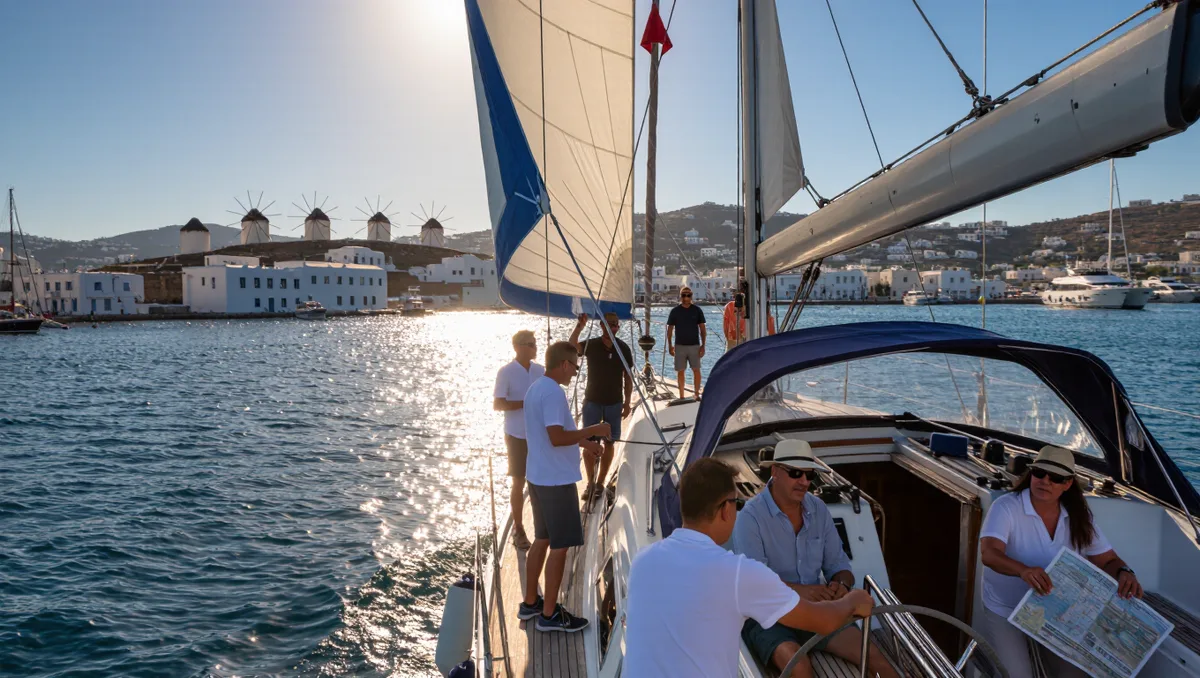
The Mediterranean works differently. It has no trades. Instead it has regional winds with names sailors learn quickly — the meltemi in the Aegean, the mistral in the Gulf of Lion, the sirocco from the south. These are seasonal and gusty rather than constant, which is why Mediterranean sailing rewards flexibility. You route around a forecast, not through it.
Then there are the high latitudes. Norway, Scotland, New England: these are wind-driven in a different way, with weather systems moving through rather than a steady regime. The sailing season is short and the weather windows are earned, not guaranteed. The reward is scenery no tropical ground can match. The Hardangerfjord: Norway at walking pace shows what that kind of slow, northern season looks like in practice.
Which destination fits which month?
The map below follows the calendar, not the brochure. Treat each band as a season, not a hard boundary — the edges shift year to year.
- December to April — the tropical winter grounds. The Caribbean is the headline: the British Virgin Islands, the Grenadines, Antigua and the Leewards all sit in steady northeast trades with dry weather and comfortable heat. This is also high season, so book early. The Pacific season starts late in this band — French Polynesia and Tonga open up toward April and run through the southern winter.
- May to June — the Mediterranean shoulder. The sea has warmed, the marinas are not yet full, and the summer winds have not settled into their strongest pattern. Greece, Turkey and Croatia are at their most forgiving. Turkey's protected southern bays suit crews who want calm water; Göçek's bays: Turkey's most protected week covers one of the best-sheltered stretches anywhere.
- July to August — the crowded, windy peak. The Mediterranean at its busiest, and the Aegean at its most demanding as the meltemi builds. This is not a month to avoid, but it is a month to route carefully and to expect company in every marina. The Adriatic's July congestion is a real planning constraint, not a myth.
- September to October — the Mediterranean's second window. Many experienced sailors consider this the region's best stretch: warm water, thinner crowds, and the summer winds easing. The western basin from the Balearics to the Amalfi Coast shines here.
- November — the hinge month. The Mediterranean closes down as the first winter systems arrive. The Caribbean season opens as the hurricane season formally ends. Boats are moving across the Atlantic on the ARC and similar rallies. It is a month for deliveries and relocations more than holidays.
Where should a first-time charter crew go?
Start where the sailing is structurally easy. That usually means line-of-sight navigation, short passages between stops, and shelter never more than an hour or two away. The British Virgin Islands are the classic answer for good reason: islands close together, trades that blow steadily rather than violently, and a well-developed charter fleet. The British Virgin Islands in seven days: a circuit that still works lays out a week that suits newer crews.
Turkey's southwest coast is the other strong candidate. The geography does the protecting for you — long inlets and bays where the water stays flat while the wind works itself into a fury outside. Greece offers more open sailing and more of a challenge; the Cyclades in particular punish crews who ignore the summer wind. The Cyclades with the meltemi in mind: how to route a week the wind won't ruin is the honest briefing on that.
What this means in practice: pick the destination for the crew you have, not the one you hope to become. A confident skipper can enjoy almost anything. A nervous one will remember the wrong trip forever.
How do you plan around the wind rather than against it?
Three habits separate smooth seasons from spoiled ones.
- Book the season, not just the boat. The same charter fee buys very different sailing in June and August in Greece. If your dates are fixed, choose the region that suits those dates — do not pick the region first and hope.
- Route with the forecast, not the itinerary. In the Mediterranean especially, the plan should bend. Sail the windy straits early in the day, save the lee shores for the calm afternoons, and keep a plan B anchorage for every leg.
- Know the named winds. The meltemi, the mistral, the bora, the sirocco — these are not folklore, they are predictable seasonal patterns with documented behaviour. Learn the one that governs your chosen ground before you leave the dock.
For the money side of the same decision — weekly rates, fuel, APA — our charter section keeps the arithmetic plain, and the life aboard pages cover what the days actually feel like once the lines are off.
The seasonal map, in short
The evidence points one way: there is no single best sailing destination, only the right destination for the right month. Winter belongs to the trade wind tropics. Late spring and early autumn belong to the Mediterranean. High summer belongs to whoever plans around the regional winds instead of pretending they are not there. The short northern season — New England in particular — rewards those who accept a narrower window; Newport to Nantucket: New England by water makes the case for it.
What remains unknown is the year-to-year detail: exactly when a season's winds will settle, how busy a marina will be, how warm the water will run. That is why the honest plan treats the calendar as a strong prior, not a promise — and why the best sailors we know of treat every forecast as new information. Pick the month, pick the ground to match, and then let the wind have the final word.