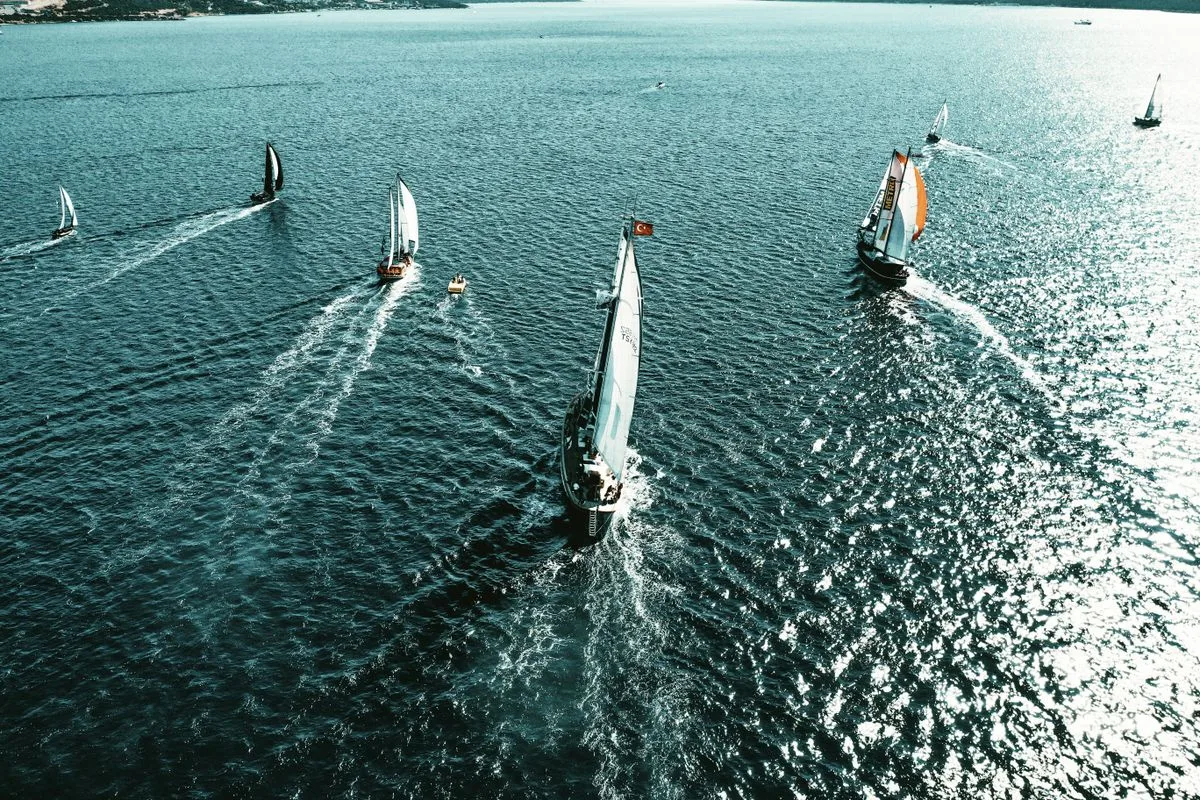
Not every regatta is the same kind of race. Some put identical dinghies around buoys for twenty minutes; others send crews across an ocean for days. The main types of sailing regattas are buoy racing, offshore and distance racing, match racing, class and one-design events, and the superyacht regattas that close the season in the Mediterranean and the Caribbean.
Knowing which is which changes how you watch. A buoy race is decided in the last hundred metres and best seen from a headland or a café terrace. An offshore race is a story told in stages, followed on a tracker over days. This guide sets out the formats, the boats and the traditions, so the next start gun makes sense.
What is buoy racing, and why is it the sport's default?
Buoy racing, sometimes called around-the-buoys or windward-leeward racing, is the format most people picture when they hear the word regatta. A course is laid out between inflatable marks set in open water. Boats sail upwind to a windward mark, return downwind, and repeat the loop a set number of times. Races are short, often under an hour, and fleets sail several races a day.
The format rewards boat handling and tactics rather than endurance. Because every race starts from a standing start near a committee boat, the first five minutes decide a great deal. If you want the mechanics of that start, our explainer on how a regatta start actually works covers the flags, horns and the countdown in detail. For related coverage, see How a regatta start actually works: flags, horns and the five minutes before the gun.
Club racing is buoy racing in its most accessible form. A local sailing club runs a series on a weekend afternoon, usually in small keelboats or dinghies, with results posted over a pint. It is the entry point for most competitors and, for a spectator, the easiest regatta type to stumble into: pick a harbour wall, arrive for the start, and the whole race happens in front of you.
How does offshore racing differ from racing around buoys?
Offshore racing trades short bursts for distance. Instead of marks, the course runs between headlands, islands or entire coastlines, and the fleet may stay at sea overnight or for several days. Navigation, weather reading and crew stamina matter as much as boat speed. Races of this type are scored either on elapsed time or on corrected time under a rating rule, which adjusts each boat's finish time for its design.
Distance races come in two broad shapes. Coastal races cover tens of nautical miles and finish the same day. True offshore races, including the classic transoceanic events, run to hundreds or thousands of miles. Our pieces on the RORC Caribbean 600 and the Rolex Sydney Hobart show what that looks like in practice: one a lap of an island chain, the other a hard downwind run to a small harbour at the end of the world.
For the spectator, the difference is pacing. You cannot watch an offshore race the way you watch a buoy race. You follow it in instalments, from the dock as boats leave, then on the tracker, then at the finish, where the arrival of a battered yacht at dawn is often the best theatre of the whole event.
What is match racing, and why do purists love it?
Match racing is one boat against one boat, usually in identical or near-identical craft, in a knockout or round-robin format. Because the boats are evenly matched, the race becomes a duel. The trailing boat can blanket the leader's wind, luff to defend, and use right-of-way rules as weapons. Penalties are given on the water and can be turned immediately, which keeps the outcome live until the finish.
The format is the foundation of professional match-racing tours and of the umpired duels that decide the sport's most famous trophy contests. It is also the most legible racing for a newcomer: two boats, one winner, no fleet to track. Watch for the pre-start, where the two helmsmen circle and jostle for position before the gun. That alone is worth the trip.
What are class regattas and one-design events?
A one-design regatta races boats built to the same specification, so the only variable is the crew. Dinghy classes, small keelboats and many modern sportsboats work this way, and their world or national championships are among the most competitive events in the sport. Nobody wins a one-design fleet with a faster boat. They win with better starts, cleaner manoeuvres and smarter choices of wind.
Class regattas also include the owner-driven classes of classic and modern yachts, where boats race under rating rules that handicap for design. The charm here is variety on the water: a single start line can hold decades of design history. Les Voiles de Saint-Tropez is the best-known example, and our guide to Les Voiles for people who don't sail explains how to enjoy it from the shore without knowing a spinnaker from a staysail. We covered a connected angle in Les Voiles de Saint-Tropez, for people who don't sail.
Maxi racing sits at the large end of this spectrum. Maxi yachts, the biggest racing and racing-cruising monohulls, gather at dedicated events where the boats are spectacular and the racing is genuine. The Superyacht Cup in Palma and the Bucket regattas in the Caribbean belong to this world, and they have their own customs.
What makes superyacht regattas a format of their own?
Superyacht regattas look like class racing, but the culture is different. The boats are large cruising yachts, often built for private use, racing with their regular crew plus professional sailors brought in for the week. Safety and seamanship carry as much weight as results, and the social calendar, dockside and ashore, is part of the event's structure. Racing is run under a superyacht rule that handicaps for size and rig, so a hundred-foot sloop and a larger ketch can compete on corrected time.
Our guide to the St Barths Bucket sets out how to watch these yachts race properly, and the Superyacht Cup Palma piece covers the Mediterranean equivalent. If you are considering combining racing with a holiday, our note on folding a regatta into your charter week explains how the calendar and the charter market interact.
Which regatta type should you watch first?
Our analysis of the calendar is simple: start where the racing is easiest to read. A club buoy race teaches you the start, the marks and the finish line in an afternoon. A class championship adds depth once you can follow a fleet. Match racing gives you a duel you can narrate to a friend. Save offshore racing and the superyacht circuit for when you want atmosphere and scale rather than minute-by-minute competition.
What the formats share is the start, the marks and the finish, and the habit of deciding races in small moments rather than grand ones. What remains genuinely unknowable in advance is the weather, which reshapes any format on the day. That is the sport's honest appeal: the course is set, the boats are counted, and the wind still gets a vote.