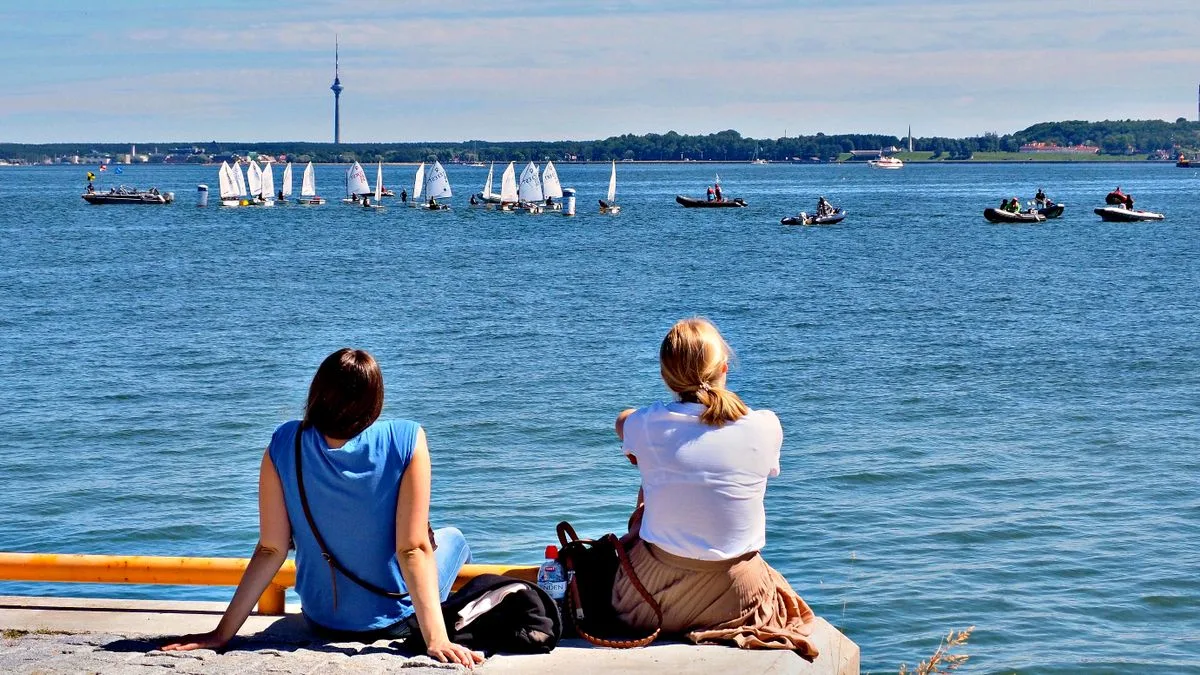
Watching a regatta well comes down to three things: knowing the shape of the course, reading the start, and standing in the right place on shore. Learn those and the boats stop looking like scattered confetti and start looking like a chess game played at eight knots.
The good news is that the learning curve is short. Most inshore racing follows the same basic pattern, repeated lap after lap, so once you have seen one race you can follow almost any fleet, from club dinghies to the maxi yachts at the big Mediterranean events.
What course are they actually sailing?
Nearly all modern inshore racing uses a windward-leeward course. The race committee sets two marks in a line with the wind. Boats start near the leeward mark, sail upwind to the windward mark, turn, sail back down, and do it again. The upwind legs are the tactical heart of the race; the downwind legs are where spinnakers go up and the fleet spreads out.
Why upwind matters so much: a boat cannot sail straight into the wind. It must zigzag, or tack, and every tack costs a little speed and distance. So the sailors are constantly choosing which side of the course to push toward, gambling on where the wind is stronger or has shifted. From shore you will see the fleet split left and right after the start. That split is not disorder. It is the race being decided.
If you can, get the course map before race day. Most regattas publish it on their website or notice board, and many now run race tracking apps. Knowing where the marks are turns a distant cluster of sails into a legible race.
How do you read the start?
The start is the most dramatic five minutes in sailing, and it rewards a spectator who knows what to look for. The starting line runs between two marks, usually a committee boat at one end and a pin buoy at the other. Boats circle behind the line, then sprint for it as the countdown finishes. Crossing early means returning and restarting; hesitating means starting in dirty air behind the fleet.
Watch two things in the final minute. First, which end of the line the favoured boats crowd toward — the end that is further upwind gives a head start on the first beat. Second, who is early. A boat luffing head to wind just before the gun has misjudged her run and will pay for it. Our guide to how a regatta start actually works walks through the flags and horns in detail. We covered a connected angle in How a regatta start actually works: flags, horns and the five minutes before the gun.
Once the fleet is away, resist the urge to watch the leader only. The interesting story is often two boats mid-fleet duelling for a single position, trading tacks down the entire beat.
Where should you stand on shore?
The best vantage point depends on the course, but a few principles hold almost everywhere.
- Get elevation. A headland, a harbour wall with steps, a lighthouse terrace or even a first-floor bar beats a flat beach. Height flattens the water into a readable map and lets you see both ends of the line.
- Pick the windward mark. Mark roundings are where positions change. A boat approaching the windward mark has right of way questions to settle at speed, and a bad rounding can lose a race that took an hour to build.
- Stand so the start line is side-on. From the side you can see the whole fleet's approach; from behind or in front you see only the front row.
- Stay near the finish if you want a result. Finishes are compressed and decisive, and the committee boat usually posts or broadcasts results quickly.
Arrive early. The good walls and headlands fill up an hour before the first start at popular events, and the race schedule often moves with the wind, not the printed programme.
What this means for your race day
Practically, plan a shore day around two or three races rather than trying to follow everything. Bring binoculars — even modest ones transform the experience. Check the tide and the sun direction; squinting into morning glare off the water is the fastest way to lose interest. And dress for the wind, not the calendar: a warm land breeze at the regatta bar is often a cold one on the exposed quay.
If you want the boats themselves explained first — the difference between a club fleet, a grand prix circuit and the superyacht classes — start with our explainer on types of sailing regattas, from club to maxi. And if the racing tempts you toward the water rather than the shore, we have a guide to folding a regatta into your charter week. Readers following this should also see Types of sailing regattas explained, from club to maxi.
Which events reward a shore spectator most?
Harbour races are the kindest to newcomers: short courses, frequent mark roundings and a fleet that passes close to the wall every few minutes. Events such as Cowes Week were practically built for shore watching, with the Solent's headlands offering a natural grandstand. Superyacht regattas are slower and more ceremonial but spectacular up close — see our guide to watching the St Barths Bucket properly. Offshore races are the hardest to follow from land: the start is the show, and after that you are waiting for a tracker.
Whatever the event, the habit is the same. Get the course, read the start, claim some height, and watch the splits rather than the leader. Do that for one afternoon and you will never see a regatta the same way again.