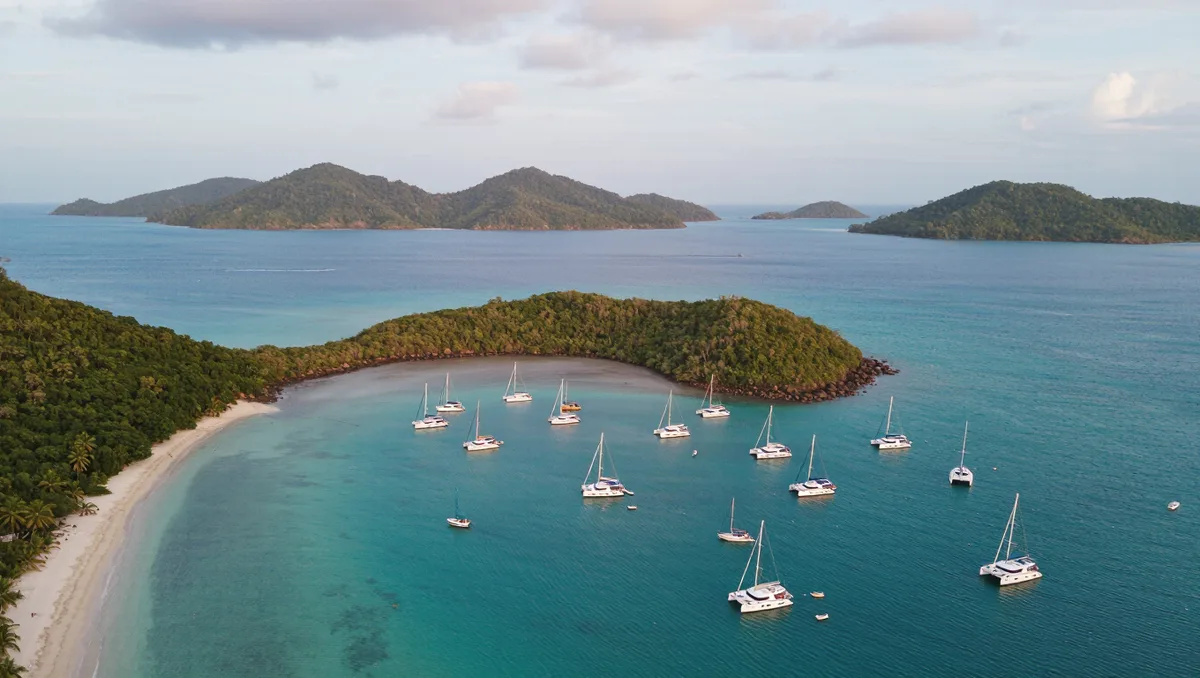
Sailing the Whitsundays rewards the skipper who plans around three or four great anchorages rather than ticking off every island. The pick of the sheltered bays sits on the western sides of Whitsunday, Hook and Haslewood islands, where the trade winds are deflected and the water stays flat. The catch is simple: the best-known anchorages fill early in the Australian winter, so the detour worth taking is the one you arrive at before mid-afternoon.
This guide ranks the region's sheltered bays in the order a working skipper would visit them on a typical seven-day loop from Airlie Beach, moving roughly north to south. Each entry covers what the bay offers, who it suits and who should give it a miss. No bay here is a secret; the value is in the sequencing and the honest trade-offs.
For the basics of choosing the boat itself, see whether a bareboat or a crewed week suits you better in Bareboat or crewed: the honest arithmetic. The rest of the network's charter coverage covers contracts, crews and costs.
Which anchorages are actually worth the detour?
The Whitsundays work as a single sheltered lagoon behind the Great Barrier Reef, which means short hops between bays and no long open-water legs. That geography is the region's real advantage: you can reposition after lunch, not just after dawn. The bays below are ranked for shelter, what they hide and how they fit together on a week's itinerary.
Whitehaven Beach and Tongue Bay
Whitehaven is the reason most visitors come, and the anchorage that serves it is Tongue Bay on the northern end. The bay itself is a working anchorage, not a destination: open to the southeast, busy by late morning, and useful mainly as the landing point for the short track over the dune to the Hill Inlet lookout. From the lookout you watch the tide write and rewrite the sand patterns across the inlet — the image every brochure uses, seen properly from above rather than from the beach.
Who should skip it: anyone wanting a quiet overnight. Tongue Bay is a day stop. Anchor early, walk the lookout, swim off the southern end of Whitehaven, and move on. The beach itself faces east and is not a swimming beach in the usual sense; the sheltered swimming is in the bays listed below.
Nara Inlet, Hook Island
Nara is the best all-round overnight anchorage in the central islands: a deep, landlocked inlet cutting into Hook Island, calm in most winds and easy to enter. What it hides is a short walk to a rock overhang with Ngaro art, evidence of the island group's long occupation — one of the few anchorages in the Whitsundays where you step ashore into something older than the charter industry. Snorkelling off the rocks at the entrance is usually the clearest water of the week.
It suits first-time bareboat crews and families, because everything is close and protected. The trade-off is that it holds many boats comfortably, so in peak season you share it. Arrive by mid-afternoon and you will still find room.
Stonehaven and the northern bays of Hook Island
Stonehaven faces west, which makes it the sunset anchorage — the one crews aim for on the evening they want the sundowner on deck rather than below. The fringing reef along its edge offers easy snorkelling straight off the transom. Neighbouring Butterfly Bay and Manta Point, on the same island's northern side, add more coral in a compact area, so you can pick whichever bay has room.
Who should skip it: crews in a strong southeast wind, since the western exposure is exactly what makes the sunset good. In settled weather it is the most sociable night of the week; in a blow, drop into Nara instead.
Cid Harbour, Whitsunday Island
Cid is the all-weather answer. A wide, deep harbour on the western side of Whitsunday Island, it takes wind from almost any direction and rarely feels crowded because it is so large. It is not beautiful in the way Whitehaven is — the shoreline is forested headlands rather than white sand — but it is where you go when the forecast turns, or when you want a calm night before an early run back to Airlie Beach.
Practical note for crews with children: Cid's size and protection make it a sensible overnight when the weather is marginal, and the general planning around younger crews is covered in Chartering with children: the week that works.
Chalkies Beach and Macona Inlet
Chalkies, on Haslewood Island across from Whitehaven, is the local's answer to Whitehaven: similar white sand, a fraction of the day-trip traffic, and a short dinghy ride from the anchorage. Pair it with Macona Inlet on Hook Island's southern side for the last night — another well-sheltered inlet, quieter than Nara, positioned for a relaxed morning motor back to the base. The ordering principle of this whole guide is shelter first, highlight second; Macona is where that logic pays off at the end of a charter.
What this means for your week
Our analysis of how these bays fit together: a loop of Tongue Bay (day), Nara (night), Stonehaven (night), Cid as the flex night, then Chalkies and Macona covers every highlight without a single long passage. The Whitsundays are small enough that the honest constraint is not distance but timing — the popular bays fill from mid-afternoon in the cooler months when charter traffic peaks, and the stinger season in the warmer months changes where you swim. Check the local marine stinger advice before deciding on snorkelling spots, and treat the winter peak as a reason to anchor early, not a reason to stay away.
Two practicalities worth settling before you leave the dock. First, fuel, water and provisioning are all at the mainland base, so plan the loop to end near Airlie Beach rather than mid-cruise. Second, the money questions — what the base rate covers and what lands later — are the same here as anywhere; the APA, explained: the money that isn't the price sets out how the advance provisioning allowance works. If you are still choosing between this region and elsewhere, the destinations section compares cruising grounds, and the broader practicalities of life aboard are collected under life aboard.
The honest conclusion
The evidence of how the region is used points one way: the Whitsundays' best anchorages are not hidden, they are simply sequenced badly by most itineraries. Tongue Bay at 11 a.m., Nara at dusk and Stonehaven at sunset is a better week than any single bay can deliver. What remains unknown for any given week is the weather, and the region's great virtue is that Cid Harbour exists as the answer to it. Plan the highlights, but plan the shelter first.